
I Have Conducted a Rigorous Academic Analysis and Toto Wolff Should Be the Next Bond Villain
This is not a joke. I mean, it is. But it’s also not.
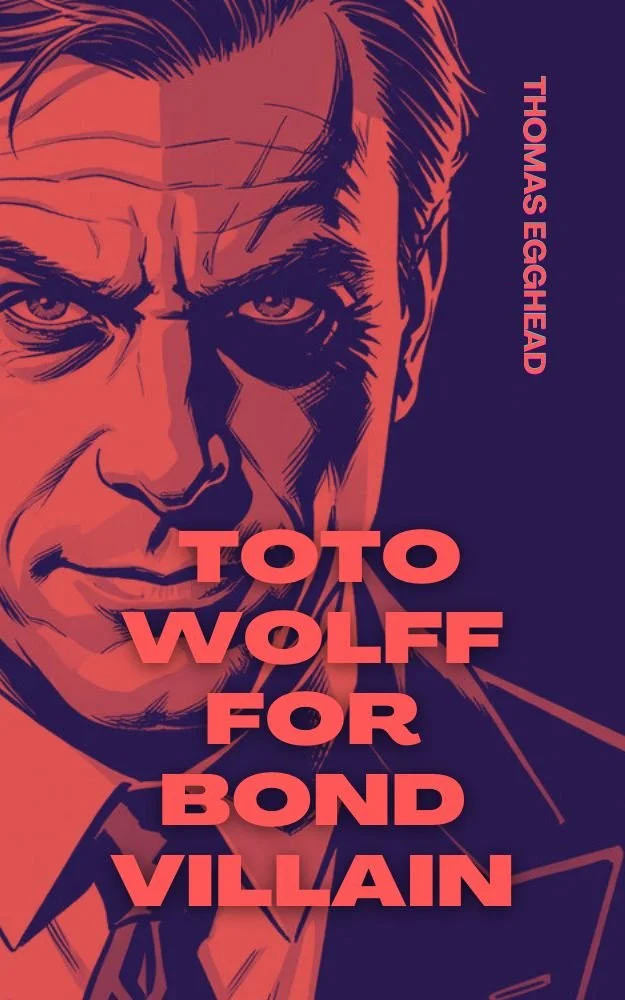
Read all about it <3
In 2021, during the final lap of the Formula One season at Abu Dhabi, Toto Wolff transmitted a message to the FIA race director that has since become one of the most replayed pieces of audio in motorsport history.
His driver, Lewis Hamilton, was about to lose a world championship he had led by eleven seconds with six laps to go, via a race-direction decision that remains disputed.
Wolff came on the radio and said, with increasing urgency: “Michael. This isn’t right. Michael, that is so not right.”
He was described, in the aftermath, as having been “visibly distraught.”
What he was, analytically, was a man whose twelve-year plan had been interrupted by an external variable he could not control.
And if you understand that this is a man who, by his own account, eats the same meals every day, owns a laminated card with his annual targets on it, and once described his management philosophy as “knowing everything that’s going on without interfering in everything that’s going on” — then you understand that “visibly distraught” does not quite cover it.
This is the premise of what is now, apparently, an actual 30-page academic dissertation: that Toto Wolff, Team Principal and CEO of Mercedes-AMG Petronas Formula One, is the single most compelling casting choice for a modern James Bond villain.
The argument is made with citations. It references Umberto Eco’s semiotic analysis of the Bond franchise. It applies the Hare Psychopathy Checklist. It invokes Burns’ transformational leadership theory and then immediately explains why the dark variant is more applicable.
The argument is also, structurally, correct.
Here is the factual profile. Wolff is Austrian, worth $1.8 billion, 6'5", fluent in five languages, a dropout who founded a tech VC firm in 1998 and sold out before the crash. He bought a stake in Mercedes for $50 million in 2013 and oversaw its appreciation to $6 billion by 2025. He commands approximately 1,400 people from a facility that journalists consistently describe in architecture terms that suggest a Bond villain lair. He has been called the world’s best-dressed boss in a profile that noted, approvingly, that “he does not wear logos” because “he IS the logo.”
“Every movie needs the good, the bad and the ugly. Now the bad is gone, it’s only Fred and I left.” — Wolff, on his rival’s departure, placing himself as protagonist.
The Bond franchise’s most credible villains share a specific structure. They have real power, not inherited but built. They have a coherent internal logic — a worldview that explains their actions to themselves without requiring villainy as the self-description. They are, in some meaningful sense, Bond’s equal: same intelligence, same resources, different ethical framework. Le Chiffre was a brilliant banker; Silva was a world-class cyberterrorist; Alec Trevelyan was literally trained by MI6. The villain works when the audience understands, briefly, why the plan makes sense from inside.
Wolff’s internal logic is exceptionally legible. He believes in the tribe. He believes in information control. He believes in long-term thinking to the point of organizational obsession. He has won eight consecutive championships using a system so dominant that when it failed in 2021 he was, by all accounts, genuinely shocked — not because he had not anticipated the risk, but because he had not accepted it as a real possibility.
A man who cannot fully integrate his own fallibility into his model of the world is a man with a structural vulnerability.
In fiction, structural vulnerabilities become plot. The hero does not defeat the villain through superior resources; he finds the crack.
The Bond franchise has, since Ian Fleming, drawn its villains from real archetypes of power. Goldfinger was modelled on a real precious metals magnate. Elliot Carver was explicitly modelled on Rupert Murdoch. The tradition is not coincidence; it is craft. Real-world power has a texture that purely invented power cannot replicate. The audience recognizes it without being told to.
The rivalry subplot writes itself. His decade-long war with Christian Horner — a man he called “a yapping little terrier” and who called him “a pantomime dame” — ended in 2025 when Horner left Red Bull under circumstances that remain complicated. Wolff texted him afterwards. The text said, in part: “Who should I fight?” Horner replied: “No one else even came close.” This is villain dialogue. This is post-credits villain dialogue.
He attended the premiere of No Time to Die. Horner was asked if the film reminded him of Wolff.
Horner dodged the question with the careful energy of a man who did not want to start something he could not finish.
Could a real person could, in good conscience, accept a fictional role on the grounds that it would simply be accurate casting.
The answer, for the record, is yes.
The full dissertation is available wherever serious pseudo-academic Bond scholarship is distributed.