When Quantum Physics Meets Cinema: Coherence, Decoherence, and the Strange Space Between
Two small independent films released only a few years apart share more than similar titles.
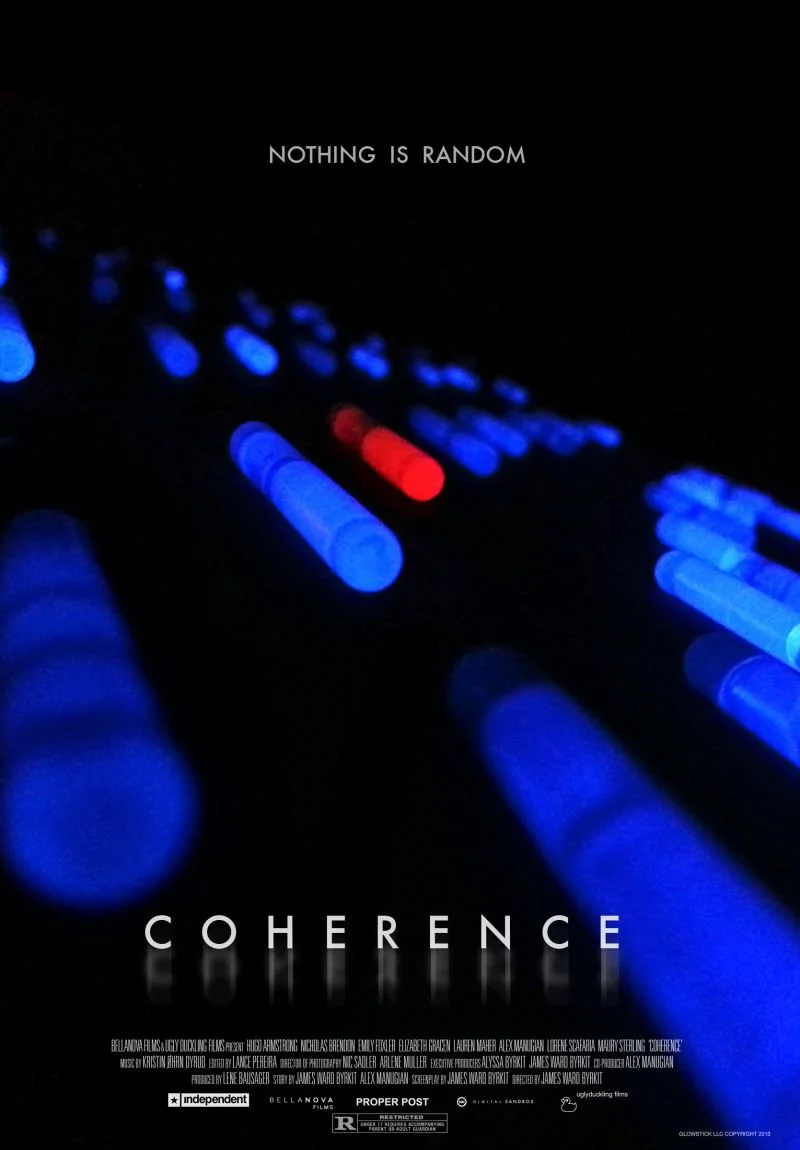
Coherence from 2013 and Decoherence from 2015 both borrow ideas from quantum physics to explore questions about identity, reality and consciousness.
One uses quantum theory as a literal engine for its plot. The other treats it as metaphor.
Seen together, they show how quantum mechanics is an effective language for thinking about the self.
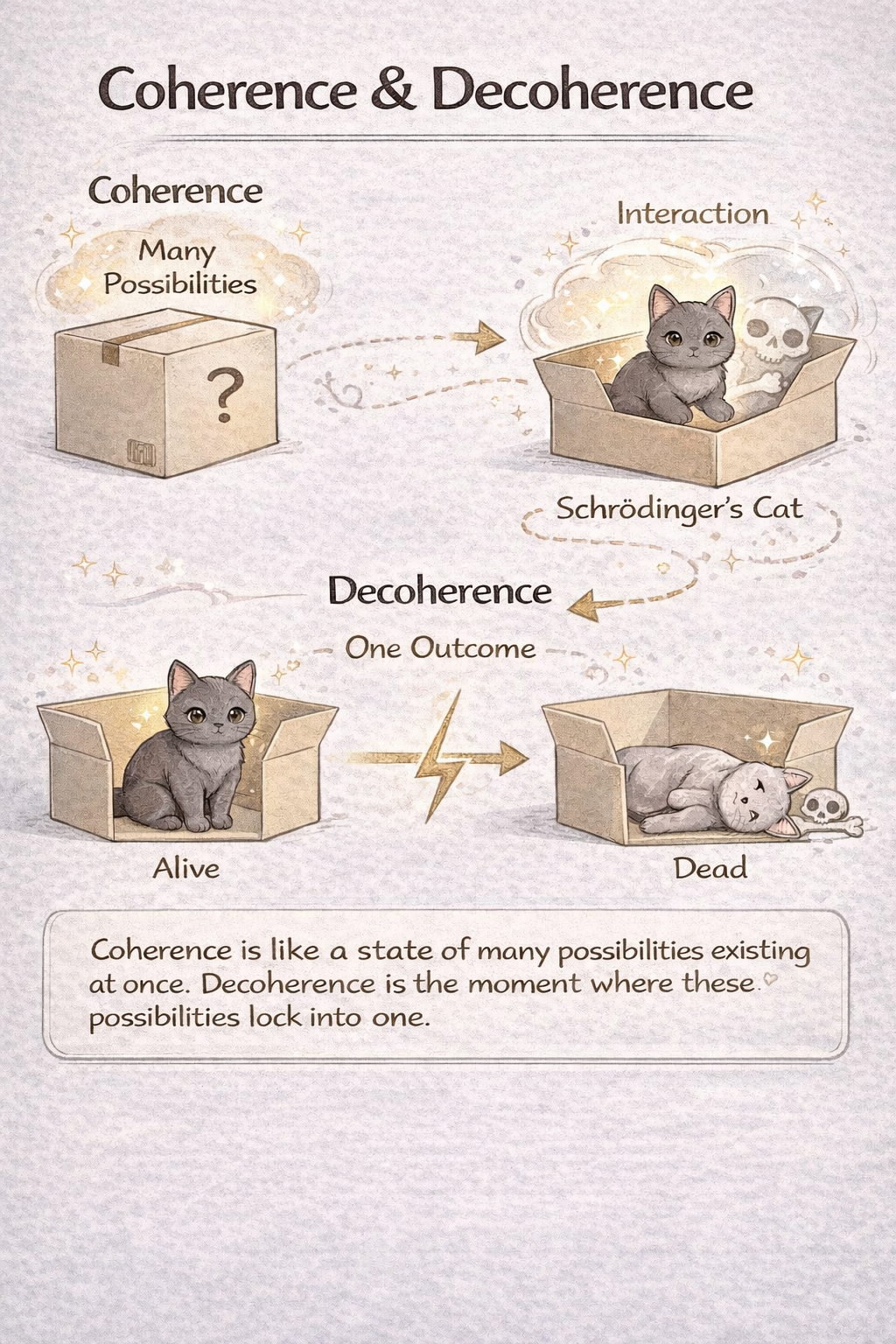
To see what these films are doing, it helps to understand the science behind their names. In physics, coherence describes the fragile state in which a system holds multiple possibilities at once. A particle can be here and there at the same time. A famous example is the Schrödinger cat thought experiment, where the cat is both alive and dead until someone opens the box. Decoherence describes what happens when this delicate state collapses through interaction with the environment. The many possibilities shrink into one. The cat becomes either alive or dead.
Coherence: When Reality Refuses to Settle
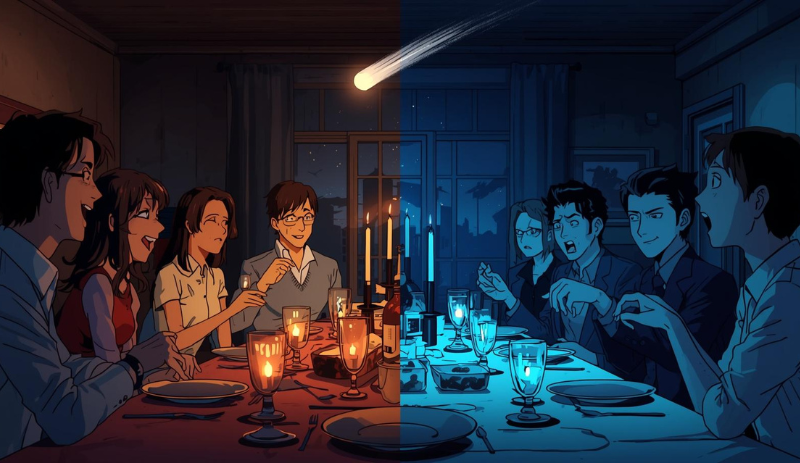
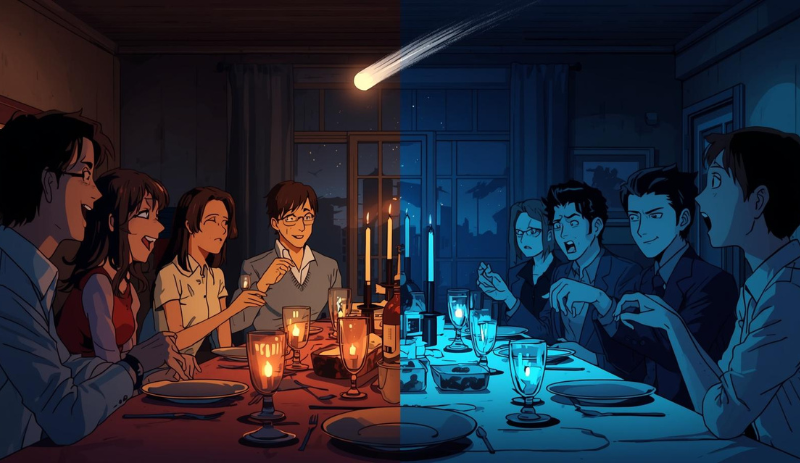
Coherence begins with an ordinary dinner party. Eight friends gather in a quiet neighbourhood on the night a comet passes unusually close to Earth. The early scenes feel familiar. Mild tensions. Old friendships. A few secrets. Then the power goes out. The group decides to check whether the outage is local and finds that a house down the street still has lights. When they knock, they discover something impossible. The people inside are themselves.
The film treats the comet as a disturbance that keeps reality from settling into one version. Instead of collapsing, multiple versions continue to exist in parallel. Each time a character steps outside and walks through the dark zone between the two houses, they risk slipping into a different version of the dinner party. They return to people who look the same but have lived slightly different hours. Phone numbers do not match. Photographs are not quite right. A haircut is off by a week.
The fear that follows is not cosmic but deeply personal. If many versions of you exist, which one is the real one. If you stumble into a reality where you have made better choices, are you allowed to take it. The film’s protagonist confronts this directly when she sees versions of herself who seem happier. She is faced with a temptation no one normally gets. She begins to think she could step sideways into a better life.
The film becomes a study of identity in a world where possibilities never collapse. Free will loses its meaning. If you can always move to another reality where you made different choices, then decisions lose weight. As the night spirals, the characters become suspicious not only of each other but of themselves.
The tension reaches a point where she tries to force reality to settle, but the ending leaves us unsure whether it worked.
Decoherence: When Memory Refuses to Hold
Decoherence takes the opposite approach. Rather than making quantum theory literal, it uses the language of decoherence to describe what it feels like to lose yourself. The film follows a man suffering from severe memory problems after an accident. He wakes each morning unsure of who he is. His wife tries to rebuild his identity by telling him their history, showing him photos and repeating small details. But nothing settles. His memories drift. He remembers events in contradictory ways. His past hovers between possibilities that never fuse into one stable story.
The film treats this as a failure of the mind’s normal collapse process. Healthy memory works by fitting new experience into what already exists. A moment enters consciousness, interacts with beliefs and emotions, and settles into a stable memory. In the film’s metaphor, this is decoherence. For the protagonist, this process breaks down. His experience remains suspended. He lives in a perpetual state of superposition where he remembers meeting his wife in different places, having children he may not have, and living events that contradict one another.
This becomes a quiet but painful exploration of identity. Philosophers like John Locke argued that personal identity depends on continuity of memory. If you cannot remember your past, are you still you. The film shows this problem from the inside. The protagonist is not simply forgetting. He is trapped in competing versions of himself. His wife tries to anchor him by holding the memories for him, but the film asks whether identity can survive outside one’s own mind. If your sense of self exists only in someone else’s recollection, is it still yours.
The film deepens the metaphor by allowing even the present to lose coherence. Scenes repeat with small differences. Conversations shift tone. Time becomes scrambled. The viewer begins to experience what the protagonist experiences, a feeling that nothing ever fully settles. The film suggests that conscious life requires enough coherence to create a continuous self. Without that, you dissolve into fragments.
Two Ways of Thinking Through the Quantum World
Seen together, these films reveal two very different approaches to the same set of ideas. Coherence stretches quantum physics across the entire world of its story. Decoherence pushes it inward, using it to describe the instability of personal memory.
Coherence imagines a world where all possibilities remain open at once. Decoherence imagines a self where nothing can settle.
One treats quantum theory as science fiction. The other treats it as a lens for understanding human vulnerability.
Both films return to the question of what makes identity possible. Coherence suggests that unlimited possibility can be terrifying. Identity needs commitment, even if that commitment shuts out other versions of ourselves. Decoherence suggests that memory must collapse into something steady for the self to exist at all. Without collapse, we drift.
Quantum mechanics has become a natural language for filmmakers because it mirrors our inner life. We feel split between versions of ourselves. We live with memories that change each time we recall them. We face choices that could lead us down radically different paths. Coherence and Decoherence have no interest in teaching physics. What they reveal is how quantum metaphors let us think more clearly about the strange, unstable nature of being human.
Together they show that reality, whether physical or personal, is something we maintain moment by moment. Too much openness leaves us lost.
Too little flexibility leaves us rigid. We live in the tension between possibility and definition. And that tenuous balance, as both films show, is where our lives take shape.