
Explaining Global Political Stagnation in 2026
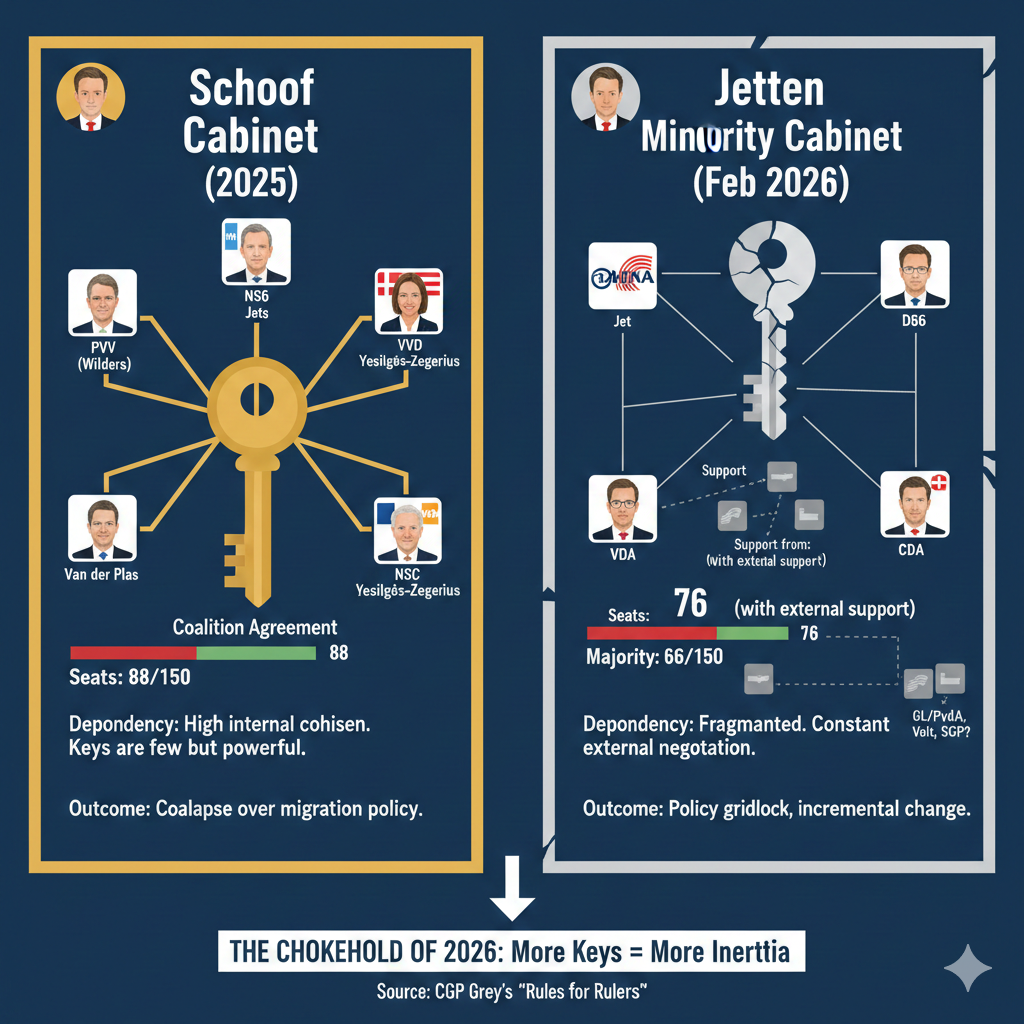
If you feel like the world is stuck in a loop of indecision, you're not imagining it. In February 2026, we are witnessing proof that political systems are built to resist change. Whether it's the new Dutch minority coalition or the EU's gridlock over the Draghi report, the same pattern repeats.
Political leaders maintain power by securing essential supporters, controlling resources, and minimizing dependencies.
This framework explains why leaders often prioritize short-term loyalty over long-term societal benefit. The result is self-reinforcing systems where meaningful change faces structural barriers.
In February 2026, this pattern appears across Dutch coalition politics, EU fragmentation, and global tensions. These aren't failures of leadership but features of how power operates.
Systems resist change because they're built to. Let me show you how this plays out at three scales.
Dutch Politics Are Fragile Alliances in the EU's Shadow
I'm Dutch, so we start close to home for me. After our October 2025 election, two parties tied with 26 seats each. Democrats 66 (D66) won slightly more votes overall. Now D66's leader Rob Jetten runs a minority coalition government with two other parties, holding just 66 seats out of 150 total. The government officially starts February 23, 2026.
What does this mean in practice? Jetten needs votes from opposition parties to pass any significant legislation. He has to negotiate constantly. He has to give concessions to everyone. This means no transformative changes, only gradual incremental improvements that keep everyone just satisfied enough.
Watch what happened in January 2026. Seven lawmakers left the Freedom Party over internal democracy concerns. This demonstrates exactly how leaders shed unreliable supporters to consolidate control over a tighter, more loyal base.
The EU Constraint
But there's a deeper problem. The European Union sets binding rules on trade, immigration, and budgets that Dutch leaders must follow.
The Dutch government can't make fully independent choices on these critical issues. They distribute EU-approved subsidies to farmers and businesses, but these supranational ties actually weaken their direct control over resources.
The result? Voters are deeply frustrated. Government approval ratings are terrible. Yet the government stays in power because the opposition is fragmented across multiple small parties that can't unite.
This proves a counterintuitive point. You can be deeply unpopular and still maintain power if the system's incentive structure works in your favor. We saw this dynamic when the previous Schoof government collapsed over immigration policy in 2025, yet the same basic coalition structure persists.
The EU’s Endless Tug-of-War
The EU is like trying to get 27 cats to walk in the same direction.
The same framework operates at a much larger scale here. Power divides among 27 member states with conflicting interests that consistently block unified action.
In February 2026, the bloc faces slow growth, industrial decline, and regulatory barriers worsened by U.S. tariffs and Chinese competition. The 2025 Draghi report urged deeper single-market integration and competitiveness reforms. Progress has stalled almost completely due to internal divisions.
Some countries propose a "two-speed Europe" where core nations like France and Germany integrate faster while others maintain more autonomy. This approach attempts to reduce dependencies and simplify decision-making, but it risks creating deeper fractures within the union.
Competing Priorities
Eurobond proposals for defense funding reveal the fundamental conflicts. Wealthier northern states prioritize fiscal caution to satisfy their domestic taxpayers. Poorer southern and eastern states seek shared EU resources for security needs.
External threats should theoretically force cooperation. Russian aggression continues. Trump's second term raises questions about America's NATO commitment. China maintains pressure on Taiwan. Yet the EU struggles to act decisively because it depends on strained U.S. security commitments it doesn't fully control.
The 2024 Migration Pact, now active in 2026, accelerates deportations and border enforcement with significant funding through 2034. Notably, it shifts burdens onto non-EU nations, allowing member states to control resources at the expense of broader humanitarian concerns.
Leaders pursue productivity investments like the Green Deal for decarbonization, but geopolitical shifts and aging populations force impossible tradeoffs.
Issues like migration abuses and poverty gaps persist not because leaders don't see them, but because satisfying specific domestic voter groups outweighs concerns about broader fairness. EU growth trails U.S. levels substantially due to debt limits and veto powers. Stalled reforms demonstrate how having more decision makers shortens policy horizons and entrenches existing arrangements.
The pattern repeats. More supporters to satisfy means more compromises, shorter thinking, and locked-in dysfunction. But what happens when we zoom out to the entire world?
Global Politics in a Rut
At the global scale, the same incentive structure drives conflict and inequality.
Current flashpoints in Gaza and the West Bank, the Taiwan Strait, and Russia-NATO confrontations all emerge as rulers consolidate power by reducing dependencies. Authoritarian leaders reward narrow elite circles with resource control while sidelining broader populations. Democracies must satisfy wider coalitions of voters, creating different constraints but similar inefficiencies. America under Trump's second term pushes isolationism to please voters who want America to stay out of world affairs and protect American industries. Tariffs and aggressive policies strain alliances. This weakens international cooperation and forces Europe toward independence it can't actually achieve.
China aligns with a small loyal group, focusing on long-term technology dominance instead of citizen welfare. Russia rewards security elites and oligarchs with resource control, enabling aggression that serves narrow interests rather than national wellbeing.
Democracies spread power wider, producing slower growth that reflects what citizens want instead of what elites want. But this wider distribution also makes decisive action nearly impossible.
Election chaos across Europe, possible shifts in American politics, and inequality-driven anger keep these cycles going. Human rights decline when leader loyalty matters more than ethics. Oil-rich dictatorships ignore their people with no consequences. Unstable regimes create unrest. Democracies make partial reforms that create instability without solving anything.
Climate action stalls despite policy promises. This proves how power structures lock leaders into bad outcomes even when everyone knows the long-term costs.
The framework explains it all. Fewer supporters enable ruthlessness.
More supporters enable paralysis. Either way, the system perpetuates itself.
Three Predictions for 2026
Based on this structural analysis, here's what I expect for the rest of the year.
The Dutch Coalition Survives but Disappoints
The Jetten minority government will survive 2026 but deliver only modest reforms, deepening voter disillusionment.
With just 66 seats, every major bill requires ad-hoc opposition support, forcing constant compromise. Expect incremental progress on housing and defense spending rising toward 2% of GDP, but stalled breakthroughs on migration or fiscal discipline.
Low approval ratings will persist amid slowing economic growth, illustrating how broad dependencies in democracies reward short-term stability over transformative change.
EU Fragmentation Deepens Despite External Pressures
The EU will experience further fragmentation despite heightened threats. Key tests like Hungary's April elections and ongoing fiscal debates will highlight competing national interests pulling against Brussels.
The Green Deal will face internal erosion, while defense and migration pacts advance slowly amid veto threats. Growth will remain subdued around 1% for the Eurozone.
This reinforces how more decision makers complicate resource distribution and shorten policy horizons, entrenching a system that muddles through rather than transforms.
Global Multilateralism Continues to Erode
2026 will solidify eroded multilateralism with no major breakthroughs in Ukraine, Taiwan, or U.S.-China relations.
Trump's second term will accelerate U.S. isolationism, pressuring Ukraine toward a Russia-favorable ceasefire and conditioning NATO commitments.
Russia will consolidate gains in Ukraine without full resolution. China will maintain gray-zone pressure on Taiwan without escalation. U.S. midterm elections in November will likely increase domestic gridlock.
Resource dependencies and weaponized trade will perpetuate instability as rulers worldwide prioritize loyalty over collective solutions.
Why This Matters
Understanding these dynamics reveals that systems resist change by design, power maintenance trumps governance quality, and the pattern scales universally.
Dependencies determine outcomes whether in democracies or autocracies, and February 2026 exemplifies structural inertia where current crises remain unresolved because power structures reward delay over transformation.
Rethinking fundamental incentives could theoretically break these cycles.
But as the framework demonstrates, power shapes rulers far more than individual rulers can reshape power structures.
That's the chokehold we're living through.
Inspiration & Resources
This analysis is deeply inspired by the political theory of "The Dictator's Handbook" and the brilliant visual breakdown by CGP Grey.
Watch: Rules for Rulers Playlist