
Playing Piano with Geometry
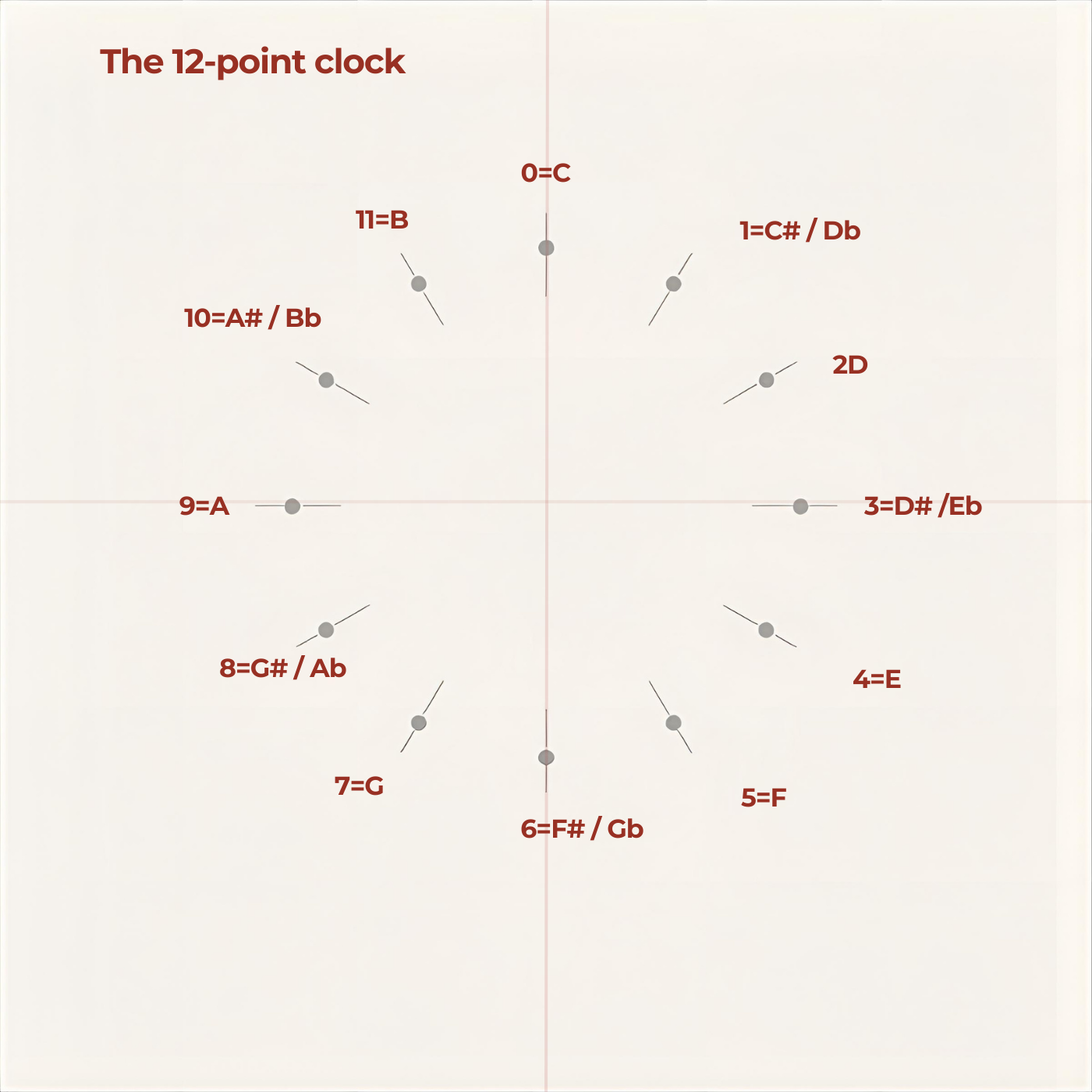
Image 1- No chord played
Traditional music theory often feels like a secret language filled with abstract names and restrictive rules that can stifle creativity.
The goal of this geometric approach is to move from abstract rules to spatial routes, treating the keyboard as a tactile playground.
This project began for me in 2019. While I was home sick, I looked for a way to learn piano without drowning in sheet music that had long faded from memory.
The 12-Point Universe
To navigate this landscape, we first simplify the keyboard. There are only 12 unique notes in our musical system, which we can model as a 12-point clock (using modulo 12 arithmetic).
In this system, every note is assigned a number from 0 to 11. This turns the infinite complexity of the piano into a finite, cyclical map of 12 points.
To walk through a landscape, you need a map. The piano has 88 keys, but its core consists of 12 unique tones that repeat over and over.
Every 12 semitones one octave the pattern starts again.
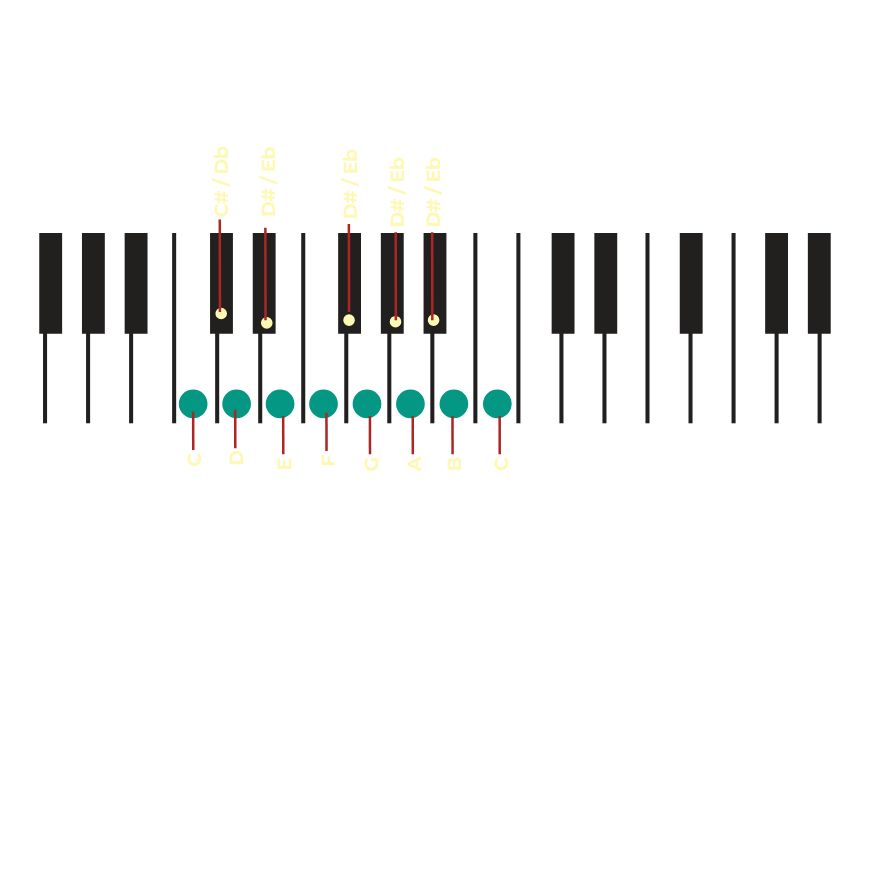
Piano Keys
You can think of this 12 point system as a circle, similar to a clock.
C is point 0. C sharp is point 1. D is point 2, and so on up to B at point 11. Then the circle begins again at C.
The Link Between the Circle and the Keys
All Cs on the piano belong to point 0 on the circle. All C sharps belong to point 1. Every note has a fixed place in the cycle. The circle works like a clock face with 12 hours.
Playing a chord is not a surface action, but the simultaneous activation of three points on the circle, which on the piano means pressing three keys at the same time.
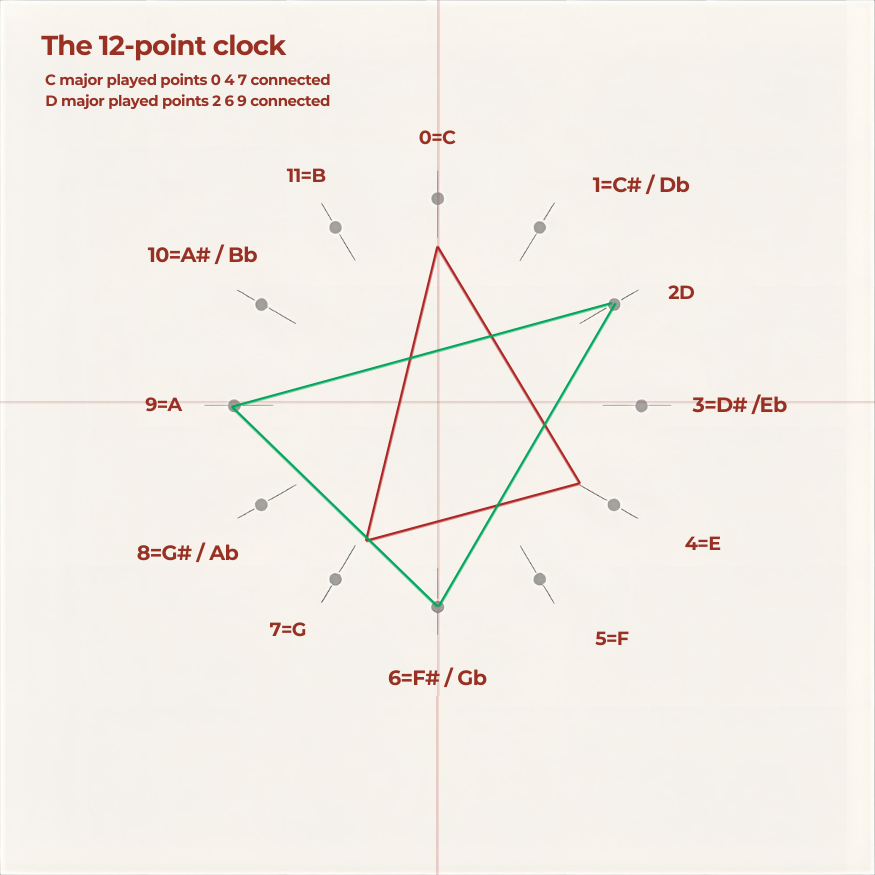
Connect those three points and you see a triangle. This triangle has three elements:
The corners are the notes themselves 0 4 7
The sides show the relationships between the notes intervals of 4 3 and 5 semitones
The shape as a whole is the architecture of the chord
Playing on the piano makes that architecture physical. You activate three points on the circle by pressing three keys at once.
The circle shows which notes belong together. Your hand builds that connection.
Does Every Chord Have to Be Geometric
Short answer: yes. Within the circle, every chord is a geometric shape, but not every shape is equally beautiful or symmetrical.
Some shapes can exist in theory, but are for now effectively unplayable. Your hand cannot form them.
What always holds: every chord with n notes creates an n sided polygon in the circle:
2 notes equals a line
3 notes equals a triangle
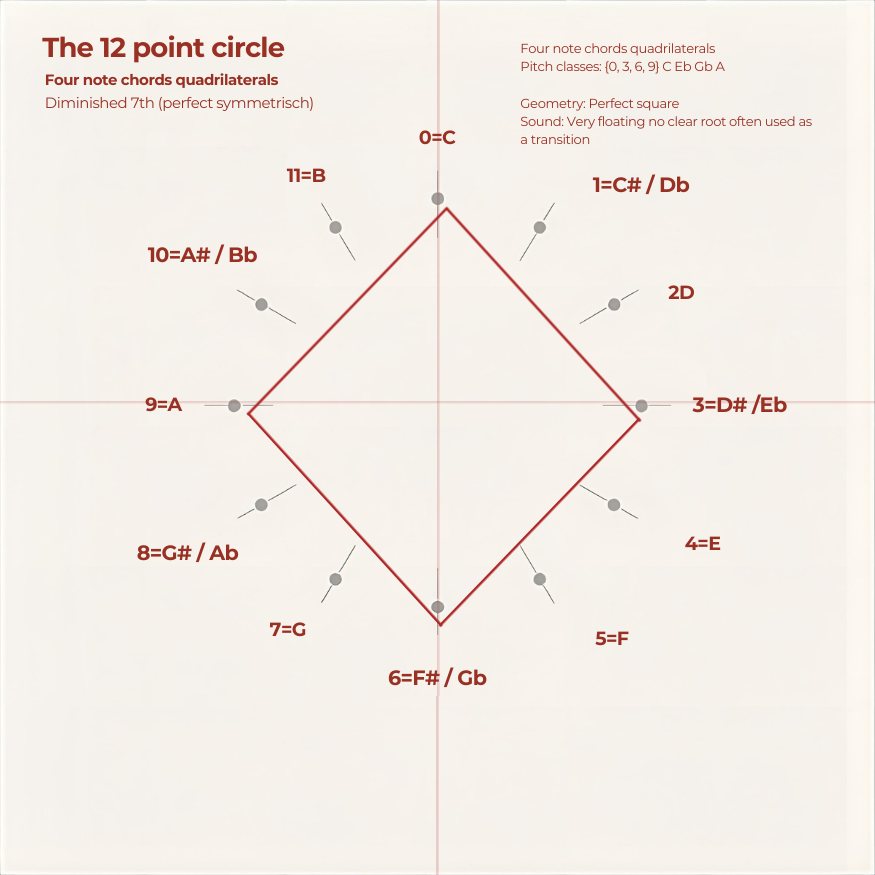
4 notes equals a quadrilateral
5 notes equals a pentagon
and so on
Not All Triangles Are Musically Equal
Symmetrical shapes augmented diminished float without a clear center
Balanced shapes major minor feel stable and consonant
Irregular shapes clusters half diminished create tension and dissonance
Geometry does not decide whether something is a chord, but how it sounds.
The more notes, the more complex the shape:
3 notes triangle simple direct
4 notes quadrilateral richer more color
5 or more notes polygon complex modern
Walking Routes with The Pivot Rule
Instead of memorizing harmonic schemes, you move through space using the pivot rule: hold one or two notes from your current chord (the "anchor") and shift your remaining fingers just one or two semitones to a neighboring chord.
In music theory this is called parsimonious voice leading. By tilting just one point of the triangle, one chord flows logically into the next.
This is the engine behind much film music. Composers like Hans Zimmer use this geometric closeness to make large emotional shifts feel organic.
Rotation Becomes Transposition
When you rotate this triangle on the circle, you shift your hand left or right on the piano.
What does this mean in practice?
C major on the circle consists of points 0 4 7. These form a triangle with sides of 4 3 and 5 semitones.
Now rotate that entire triangle two steps to the right on the circle. Each point shifts by 2:
Point 0 becomes point 2
Point 4 becomes point 6
Point 7 becomes point 9
This gives you points 2 6 9, which is D major D F sharp A. The sides remain 4 3 5.
The shape is identical. Only the position on the circle has changed.
Your hand was on C E G. Now your hand is on D F sharp A. You moved two keys one whole tone to the right.
But the distance between your fingers is exactly the same.
Thumb to middle finger is still four semitones. Middle finger to pinky still three semitones.
This is transposition: playing the same chord in a different key.
The geometry on the circle rotation translates into a physical shift on the keyboard, while your hand shape remains constant.
Your Hand Feels the Geometry
This theory is not just for your head, but especially for your fingers.
Because the geometry stays constant, you only need to learn one shape for all 12 major chords.
Without the circle, the piano is a linear row of keys with names attached.
The circle makes harmony cyclical. You walk in loops by choosing different routes and return to where you began.
This method rests on concepts that have existed for centuries.
Pitch class set theory uses numbers for tones 0 equals C, 1 equals C sharp, and is standard in conservatories.
The circle of fifths organizes the same 12 tones by fifths instead of semitones.
And Euler already drew chords as triangles in his Tonnetz in 1739.
What’s new is translating all of this into a directly playable piano system with almost no theory required upfront. You learn the circle not to memorize rules, but to feel proximity.
See you at the keys