
I love this movie: Coherence
It all begins with an idea. Maybe you want to launch a business. Maybe you want to turn a hobby into something more. Or maybe you have a creative project to share with the world. Whatever it is, the way you tell your story online can make all the difference. Don’t worry about sounding professional. Sound like you. There are over 1.5 billion websites out there, but your story is what’s going to separate this one from the rest. If you read the words back and don’t hear your own voice in your head, that’s a good sign you still have more work to do.

Glow sticks in "Coherence": False beacons in a fractured multiverse
The colored glow sticks in James Ward Byrkit's 2013 film represent humanity's futile attempt to impose order on quantum chaos—simple objects that promise certainty but deliver only the illusion of control. In a $50,000 film shot over five nights with improvised dialogue, these mundane emergency supplies become the visual language through which eight dinner party guests try to track their identities across infinite parallel realities. Their failure mirrors the film's central thesis: when confronted with the multiverse, our tools for making sense of reality—and ourselves—inevitably break down.
The glow sticks originate from an earthquake kit as the lights go out
When Miller's Comet passes overhead and plunges the dinner party into darkness, host Mike retrieves glow sticks from his emergency supplies. He offers three boxes—blue, red, and green—and the group collectively chooses blue. Each person takes one, establishing what they believe is a simple identification system. This mundane choice becomes cosmically significant: across infinite parallel realities, other versions of the same group made different selections. Some opened the red box. Others chose green. A trivial decision about emergency lighting becomes the first branching point distinguishing one reality from another.
Director Byrkit deliberately designed the glow sticks as the film's visual anchor. In a 2014 ScreenAnarchy interview, he explained: "We called the glowsticks 'The Barrels' as we hoped they would function in the same way as Spielberg used those yellow barrels in Jaws; when the two barrels appeared, you just know that the sharks are underneath." The approach was born from constraint—"I just happened to have a few glowsticks around the house, and they looked so good on film when we did this test. I was like, 'Oh, that is it. That is it. Follow the blue glowstick.'"
The tracking system establishes a deceptively simple binary
When Emily, Mike, Kevin, and Laurie venture outside to investigate a lit house down the street, they carry their blue glow sticks like protective talismans. On the way, they encounter another group of four people who look exactly like them—carrying red glow sticks instead of blue. Both groups flee in terror, and the survivors return to report the encounter. The initial logic seems straightforward: blue glow stick equals "our" house, red equals "theirs." The characters believe they've discovered a reliable authentication method.
The group quickly elaborates their system into what amounts to multi-factor authentication. They create marker boxes containing:
Photographs of each person
Dice-rolled numbers written on the backs (six-sided dice creating unique numerical identifiers)
Ink color matching their glow sticks (blue ink for the blue glow stick house)
A random object per person—ping-pong paddle, oven mitt, stapler, coaster, napkin
The mathematical complexity is staggering. As Hugh calculates, there are 5,038,848 possible combinations (6^8 × 3)—representing dice numbers, people, and glow stick colors. The characters believe this elaborate bookkeeping will protect them from imposters and help them verify their identities. They are wrong.
Hugh and Amir reveal the system's first catastrophic failure
The breakdown comes when Hugh and Amir—who left earlier to find a working phone—return to the house. Mike confidently states that everyone present has blue glow sticks. Hugh and Amir produce theirs: they are red, not blue. The discovery sends a chill through the room. These two men carry the wrong color, meaning they are not from this reality. They crossed through the dark zone and entered a different house without realizing it.
The original Hugh and Amir who left the blue glow stick house are gone forever, wandering somewhere in the multiverse. The versions now present came from a red glow stick reality. They themselves didn't know they had shifted until confronted with the color mismatch. One analysis notes additional evidence: Hugh's forehead bandage appears different than before—a subtle visual cue that even this man's recent history has diverged.
The horror deepens when another Hugh and Amir arrive later—these carrying blue glow sticks and reporting they were trapped in a red house where they found two identical notes. The tracking system hasn't just failed once; it's collapsed entirely. Multiple realities share the same glow stick color. The simple binary (blue/red) was always an illusion. There are at least three color-coded realities interacting, and likely infinite variations within each color category.
The dark zone functions as a quantum boundary between worlds
The "dark zone"—a particularly dark area of the neighborhood outside the house—serves as the portal between realities. Anyone crossing through this zone emerges into a different parallel universe, "like a ball on a roulette wheel." Characters cannot choose which reality they enter. Each trip outside is a gamble that might strand them forever in an unfamiliar timeline.
Byrkit designed the dark zone to carry thematic weight beyond its plot function. In interviews, he explained the significance of the film's black cuts and transitions: "Once we tried that editing thing... we realized that thematically it is all about the lights going out, these dark spaces. Whether it is the dark spaces between human beings, the dark places in your heart. How you lose yourself to yourself." The physical darkness between houses mirrors the psychological darkness within relationships—the unspoken resentments and fears that the comet's chaos forces to the surface.
The dark zone embodies quantum decoherence theory's "measurement problem." In physics, quantum coherence allows particles to exist in superposition—simultaneously occupying multiple states—until observation collapses them into classical reality. The comet temporarily breaks this decoherence, allowing normally separate realities to overlap. The dark zone is where this collapse happens to human beings: crossing it is the "observation" that determines which reality you inhabit.
Quantum decoherence theory explains the film's title and premise
The title "Coherence" is deeply ironic. In quantum physics, coherence refers to a system maintaining superposition—existing in multiple states simultaneously. Decoherence is when interaction with the environment causes superposition to collapse into classical, determinate reality. Under normal circumstances, quantum decoherence keeps parallel universes separate and unable to affect each other.
The comet breaks this rule. As explained in the film through Hugh's physicist brother's notes, the comet creates a temporary state of coherence between realities that should remain separated. Dr. Radha Pyari Sandhir, a physicist who analyzed the film for Film Inquiry, explains: "The Many Worlds Interpretation, which the film seems to refer to though not by name, involves the various components in a superposition decoupling from one another, evolving independently, and existing in their own classical realities."
The film explicitly invokes Schrödinger's cat: "There's a cat in a box that has a 50/50 chance of living because there's a vial of poison that's also in the box... quantum physics says that both realities exist simultaneously. It's only when you open the box that they collapse into a single event." The characters realize their situation: "We're in the box. We're the cat. We're both alive and dead." By the ending, Emily literally becomes Schrödinger's cat—hidden in a trunk, existing in an indeterminate state until someone opens it and collapses her fate.
Byrkit designed the comet as mythic archetype and the phones as talismans
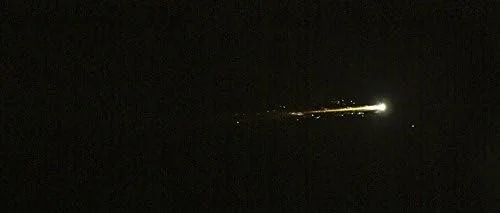
Beyond physics, Byrkit conceived the comet as a fairy-tale device carrying ancient symbolic weight. He told Starburst Magazine: "A comet seemed right because they are the perfect blend in our minds of ancient legend and modern science. They've always been a harbinger of some kind, a sign, something that is clearly special and cosmic but beyond our understanding." The comet signals to audiences that "this is more of a fantasy concept than hard science fiction"—closer to fable than physics lecture.
The director explicitly framed the film's objects as talismans—magical protections the characters clutch in desperation. In the ScreenAnarchy interview, when the interviewer described phones as "talismans" and "links to identity," Byrkit agreed: "Well these are items we hold onto to control your identity. That is the whole thing." He elaborated: "We talked about this a lot early on. What do people latch onto to know what is real... whether it is the vase, the monkey in the box, the colour of the pen, the ring. Everything around them they are using as proof because they end up not trusting their own vision."
This makes the glow sticks not just plot devices but ritualistic objects—modern talismans the characters hope will ward off identity dissolution. The phone's crack, Hugh's bandage, the glow stick color—each becomes a desperate attempt to anchor selfhood when the universe offers no stable ground.
The glow sticks as failed identity markers illuminate the film's existential horror
The tracking system's ultimate failure carries profound philosophical implications. Critics have interpreted the glow sticks as representing what Film Inquiry calls "false clarity"—the illusion that identity can be verified, categorized, and protected through external markers. The film systematically destroys this illusion.
By the climax, almost none of the original eight friends remain in their home reality. Aside from Lee and Beth (who never left the house), everyone present has unknowingly arrived from different timelines. The glow stick verification, the photographed dice numbers, the random objects—all have failed. The elaborate bookkeeping cannot account for a multiverse where infinite variations share the same color-coded markers.
Matt Zoller Seitz, reviewing for Roger Ebert's site, identified the film's true subject: "What's being threatened in 'Coherence' is who they are, or what they think they are; not just the integrity of their bodies (though that's at risk, too) but their identities." The horror isn't violence but epistemology—the characters cannot know who they are, who anyone else is, or whether reality itself remains stable. The glow sticks promise answers but deliver only deeper uncertainty.
Emily's arc shows how the multiverse enables "shopping for better timelines"
Emily (Emily Foxler) begins the film as a sympathetic character—a dancer whose career suffered when another woman replaced her in a major production. She refused to become the replacement's understudy, letting pride cost her everything. This backstory establishes her regret about missed opportunities, which the multiverse transforms into dangerous possibility.
As chaos escalates, Emily realizes she can actively search for a better version of her life. She ventures outside repeatedly, examining different houses, looking for a reality where things turned out differently. When she finds one—a happy dinner party where her relationships remain intact and her counterpart's life appears better—she makes a devastating choice. Emily knocks out her alternate self and attempts to take her place, hiding the unconscious double in a car trunk.
Critics have noted the moral horror of this decision. Dark Film Theories observes: "Emily, typically seen as gentle and sympathetic, knocks out her alternate self to steal that life—an unmistakable moral breach." The film foreshadowed this transgression: earlier, Emily complained about the dancer who "stole her life." Now she does the same to another version of herself. The glow sticks, which promised to identify friend from foe, become irrelevant—the greatest threat Emily faces is herself.
The ending reveals that color-coded certainty was always an illusion
Emily wakes in the "better" reality believing she succeeded. The morning light suggests safety; the comet has passed; realities should be fixed. Then Kevin finds her ring in the bathroom—but she's wearing one too. Two rings exist. His phone rings: Emily is calling from outside.
The screen cuts to black. Emily Prime faces an impossible reckoning: the Emily she knocked unconscious has regained consciousness and is reclaiming her timeline. Byrkit told Yahoo! News that "he originally intended for Emily's story to have a more optimistic conclusion. However, he ultimately went with something more uncomfortably honest."Emily's violence toward her double didn't justify an idealistic ending.
The glow sticks, absent in this final scene, remain as ghostly symbols of the night's failed authentication attempts. Emily cannot verify which reality she belongs to because belonging itself has become meaningless. As Signal Horizon's analysis concludes: "Emily Prime will not be able to live happily in that reality because the other Emily is going to fight to take her identity back. When it comes to cross-questions, Emily Prime will have gaps in the events of the reality."
Conclusion: The glow sticks illuminate the impossibility of fixed identity
Byrkit's genius lies in using mundane objects to communicate profound ideas. The colored glow sticks function simultaneously as narrative device, visual metaphor, and philosophical statement. They represent our desperate need to categorize reality, verify identity, and maintain the illusion that we know who we are. Their failure—progressive, inevitable, complete—demonstrates that in a multiverse of infinite possibility, no marker can establish authentic selfhood.
The film's title gains final ironic weight: "Coherence" describes what the comet destroys (quantum decoherence between realities) and what the characters desperately seek (coherent, stable identity) but cannot achieve. The glow sticks glow brightly in the darkness, promising guidance. They illuminate nothing except the characters' futile faith that simple color-coding can save them from existential dissolution. In Byrkit's fable of the multiverse, there are no reliable beacons—only false lights leading everywhere and nowhere at once.