
TIMELINE OF THE LOUVRE HEIST
When this broke, I barely noticed. Because my true name is Patrick Star and I live under a rock.
But, recently a meme reminded me that this had actually happened in 2025. So, armed with tea and wifi I read up about the Louvre robbery and soon I realised how much it sounded like a Pink Panther movie plot. I spent a whole evening deep diving. Here's what happened and what we know now.
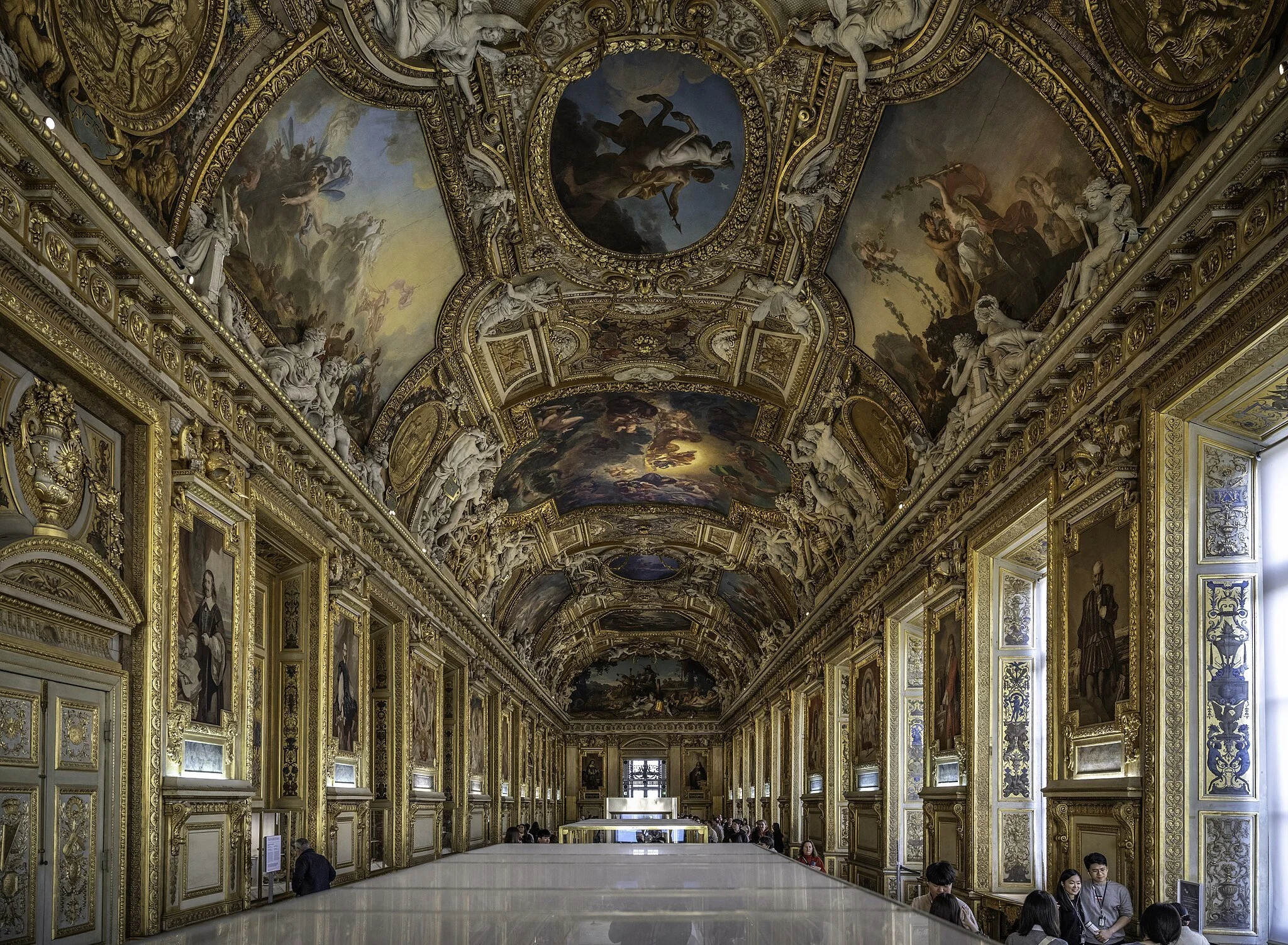
Galerie d'Apollon (Louvre)
In October 2025 four thieves dressed as renovation workers used a truck-mounted lift on the Seine side of the Louvre to reach a balcony at the Galerie d'Apollon.
They entered through a window during public hours and broke several display cases and stole eight items from the French crown jewels collection worth tens of millions of euros.
The whole thing took under seven minutes. They escape on scooters (Is this the real life is this just fantasy?).
The museum evacuated and closed immediately. A crown belonging to Empress Eugénie turned up near the scene, but the other pieces are still missing. Within a week police arrested several suspects in their 30s believed to be connected to the robbery. Multiple people face charges, though the jewels remain lost.
Parliamentary hearings revealed gaps in the Louvre's security. There weren't enough outside cameras and the thieves exploited obvious vulnerabilities.
As of early 2026 the stolen jewels have not been recovered. Authorities are still pursuing suspects. The theft sparked wider concern across French museums about cultural property security, triggering nationwide alerts and audits of vulnerable collections. The 2025 theft is now the most significant Louvre robbery since the 1911 Mona Lisa theft, when the painting went missing for years before being recovered.

Louvre Museum, CC0, via Wikimedia Commons, tiara of Empress Eugénie de Montijo
Here is a timeline of the 2025 Louvre jewel heist
19 October 2025 around 09:30 local time thieves disguised as workers arrive in a truck with an aerial lift on the Seine-side facade of the Louvre.
They raise the lift to the first-floor balcony of the Galerie d’Apollon, smash a window, cut open two high-security cases and steal eight pieces of French Crown Jewels in under eight minutes while the museum is open to visitors.
One crown is dropped and later recovered damaged.
19–20 October 2025 the Louvre is evacuated and closed for the day, Interpol adds the stolen jewels to its Stolen Works of Art database, and global shock ripples through cultural institutions.
20–22 October 2025 the Louvre reopens with the Galerie d’Apollon closed. The museum director acknowledges security shortcomings to French lawmakers. Critics highlight gaps in CCTV coverage and years of delayed upgrades. Tongues are starting to waggle.
25 October 2025 two suspects in their 30s are arrested, including one at Charles de Gaulle Airport attempting to leave. Police seize tools, DNA, prints and trace evidence.
Late October 2025 French prosecutors expand the probe. Five more suspects are detained. Two additional individuals receive preliminary charges for organised theft and conspiracy. None of the missing jewels have been publicly recovered.
By November 2025 political fallout intensifies. The theft is framed nationally as both heritage loss and governmental failure. Security audits show the museum had under-monitored zones facing the Seine and decades of insufficient external cameras.
Today the investigation continues with suspects charged or under scrutiny, investigators analysing surveillance and evidence trails. Authorities maintain that the stolen items remain missing and could have been melted down or trafficked into private markets.

François-Régnault Nitot, CC0, via Wikimedia Commons
Conspiracy theories and fringe speculation
Rumors suggest insiders with knowledge of security gaps may have helped plan the heist, but no evidence has surfaced. Prosecutors stress the charges are for organized theft, not insider complicity. Some speculate the jewels were funneled to wealthy collectors or underground markets, though law enforcement says these channels are monitored and the pieces remain missing.
Online threads claim the visible gaps in CCTV coverage were left intentionally for aesthetic reasons tied to tourism photo spots. Critics use this to argue the museum prioritized the wrong things, though there's no proof this was actual policy. A fringe idea persists that the thieves wanted to create a narrative of cultural vulnerability to force museum funding and reforms. This lacks any substantiation and remains pure speculation.
Speculation for an other article :)
Here’s the confirmed list of the stolen items stolen and what they represent in historical and cultural terms
• The tiara, necklace, and single earring from the sapphire set of Queen Marie-Amalie and Queen Hortense. A 19th-century parure worn by French royalty that featured sapphires and diamonds and symbolised dynastic alliances under the First French Empire and July Monarchy.
• The emerald necklace and pair of emerald earrings from the emerald parure of Empress Marie-Louise. These were gifts from Napoleon to his second wife in 1810, reflecting Napoleonic imperial ceremony and personal symbolism.
• The tiara of Empress Eugénie de Montijo. An ornate diamond piece reminiscent of the Second Empire’s splendour.
• The large bodice bow (corsage brooch) of Empress Eugénie. A decorative item studded with gems, part of Eugénie’s personal jewellery collection.

Remi Mathis, CC BY-SA 4.0 <https://creativecommons.org/licenses/by-sa/4.0>, via Wikimedia Commons
• The reliquary brooch. A historically significant brooch associated with Empress Eugénie, sometimes described in detail by collectors for its unique diamond settings.
Also important is what they did not take
The Apollo Gallery also contains headline stones like the Regent, Sancy and Hortensia, which commentators noted were not targeted.
Reported totals include about €88 million and about $102 million, depending on the source and conversion at the time.
Why there is no exact price tag
Museums tend to give aggregate estimates because each object’s value includes provenance, uniqueness, and heritage loss, not just carats and metal weight.
Prosecutors echoed that the larger loss is historical.
Unlike a famous painting, jewellery can be dismantled into components that are hard to prove came from a specific object, especially with older stones that may lack modern identifiers.
Where we are today
When writing this the jewels are still missing. While the Louvre and French authorities have moved to tighten security, including bars installed on the breach point and plans for more cameras and policing.
But as JoJo sang, too little too late.