Why I Haven’t Bought the Dyson Airwrap
I am hesitant to buy the Dyson Airwrap. Not because I doubt that it works, but because I have made this mistake before. I have bought the wrong dupe. More than once.
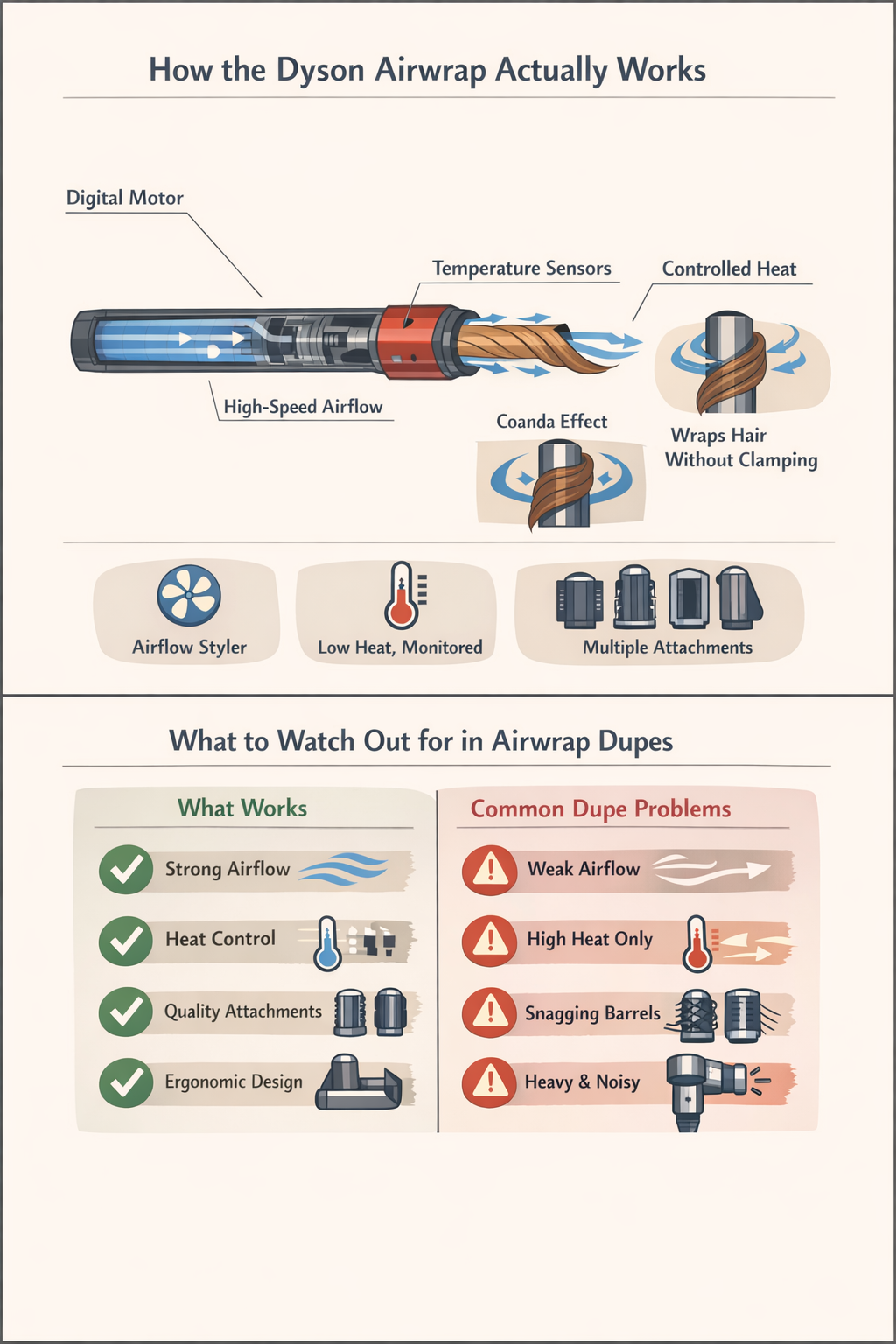
They promised the same result. They looked right, felt convincing, and failed the moment they touched real hair. This is not a recommendation. It is an attempt to slow myself down and understand what actually matters before spending money again. To choose well, I first needed to understand what the Airwrap is doing beneath the branding and the aesthetic. The Dyson Airwrap is often described as a styling tool that does everything.
Behind that claim sits a specific technology and a clear design logic. Understanding how it works explains why some dupes perform well and why others fall short.
The technology behind the Airwrap
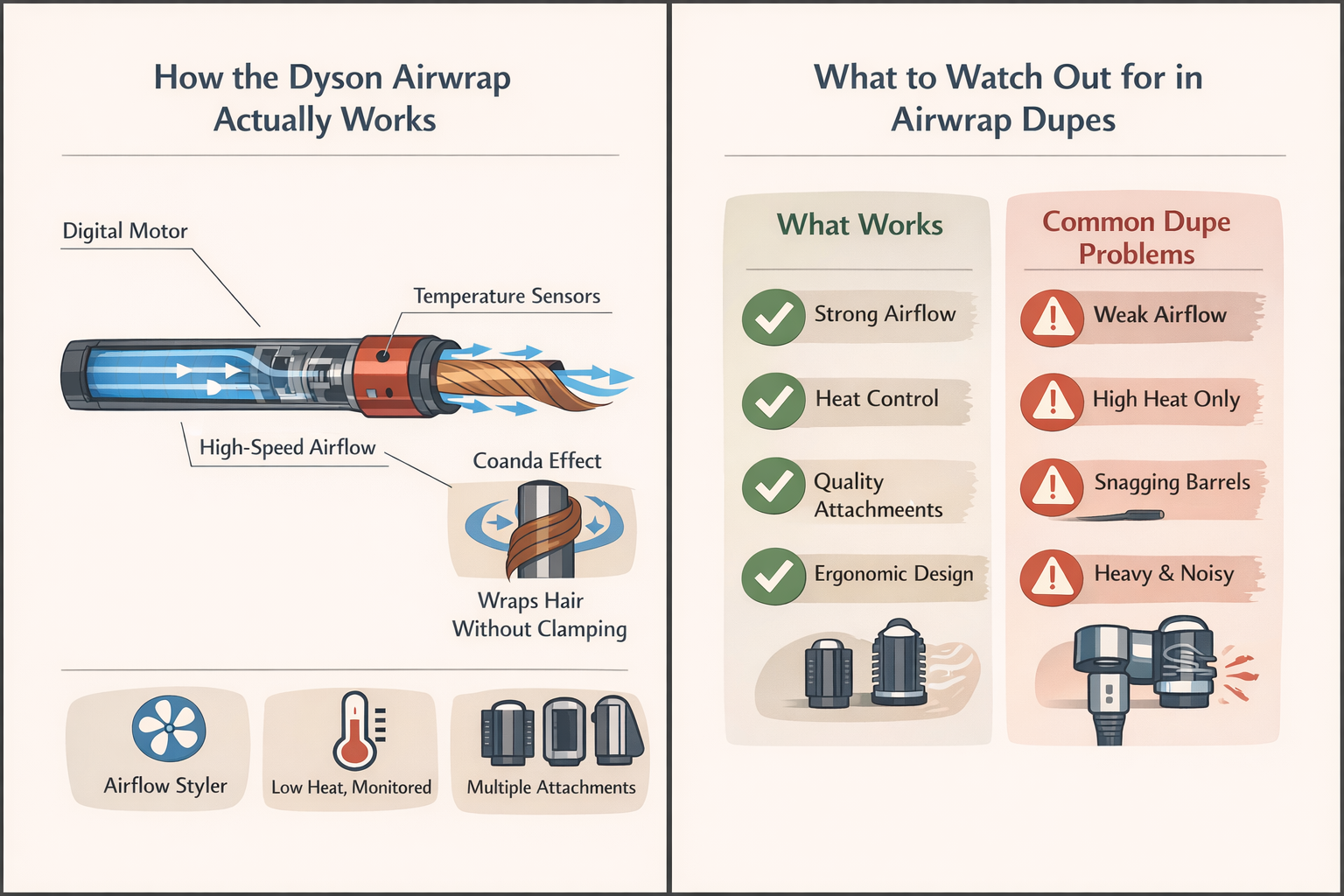
The Airwrap does not rely on a traditional heating element to style hair. It uses controlled airflow combined with regulated heat to shape hair while limiting thermal damage. A high speed digital motor generates a focused stream of air. The shape of the barrels and brushes directs this airflow to create the Coanda effect. This effect causes air to cling to a surface, drawing hair toward the barrel and wrapping it around without clamping. Curling, waving, or smoothing happens because airflow does the work, not because hair is pressed against extreme heat.
The tool also monitors temperature continuously and adjusts output to keep heat below damaging thresholds. This places it closer to a heat managed styling system than to a conventional iron or wand.
In practical terms, the Airwrap styles hair by using high velocity airflow to attract and wrap hair around attachments, applying minimal direct heat with active temperature control, and offering multiple attachments for drying, smoothing, and shaping.
Why the airflow matters
Most styling tools depend on direct heat and pressure. Flat irons compress hair between hot plates. Curling wands require repeated wrapping around a heated rod. The Airwrap’s approach differs in meaningful ways.
Hair is shaped with less cumulative heat exposure. Sections are styled without flattening the cuticle. The absence of clamping reduces mechanical stress. The result is less frizz and fewer concentrated heat points that lead to breakage.
Finding a dupe: what matters
Many brands now sell Airwrap style tools. Some offer genuine value. Others rely on visual similarity rather than functional equivalence.
When evaluating a dupe, the underlying mechanics matter more than the finish. I now ignore marketing language and focus on evidence. I look for demonstrations on real hair without excessive passes. I read reviews that discuss airflow strength rather than surface shine. I check whether heat limits and control are clearly stated.
If a tool only works on very thin sections or requires repeated high heat passes, it is not operating on the same principle as the Airwrap.
Three Tools That Do Match the Checklist
I am not endorsing these. They are simply the tools that currently meet most of my criteria on paper.
Shark FlexStyle
Strong airflow, multiple heat settings, thoughtful attachment design. Frequently cited as the closest functional match in terms of airflow logic rather than looks.
BaByliss Air Style Series
Good airflow focus and solid heat control. Fewer attachments, but better execution than many visually flashier options.
T3 AireBrush Duo / Aire360 line
More conservative design, but strong attention to heat management and airflow balance. Less hype, more engineering.
I have not decided which, if any, I will buy.