
Formula 1 2026 Rules: A New Era
Formula 1 Just Hit the Reset Button. This article explains why 2026 changes everything you know about racing.
Forget everything you think you know about Formula 1.
For the last decade F1 has been a straightforward equation. Massive downforce plus efficient hybrid engines equals victory. The cars were fast, faster, fastest.
Brutally fast, but they were also bloated. Monaco can look awkward sometimes.
These cars are heavy and wide, too reliant on ground effect aerodynamics that punished anyone trying to follow closely.
Races often became high-speed parades where the starting grid predicted the podium.
In 2026, the FIA is blowing up that formula entirely.
This is not a tweak or simple adjustment. This is the single largest regulatory overhaul in the history of Grand Prix racing.
The governing body has rewritten the fundamental laws of physics that teams must obey, and the consequences will be dramatic.
The Cars Are Shrinking
After years of expansion, Formula 1 cars are finally going on a diet.
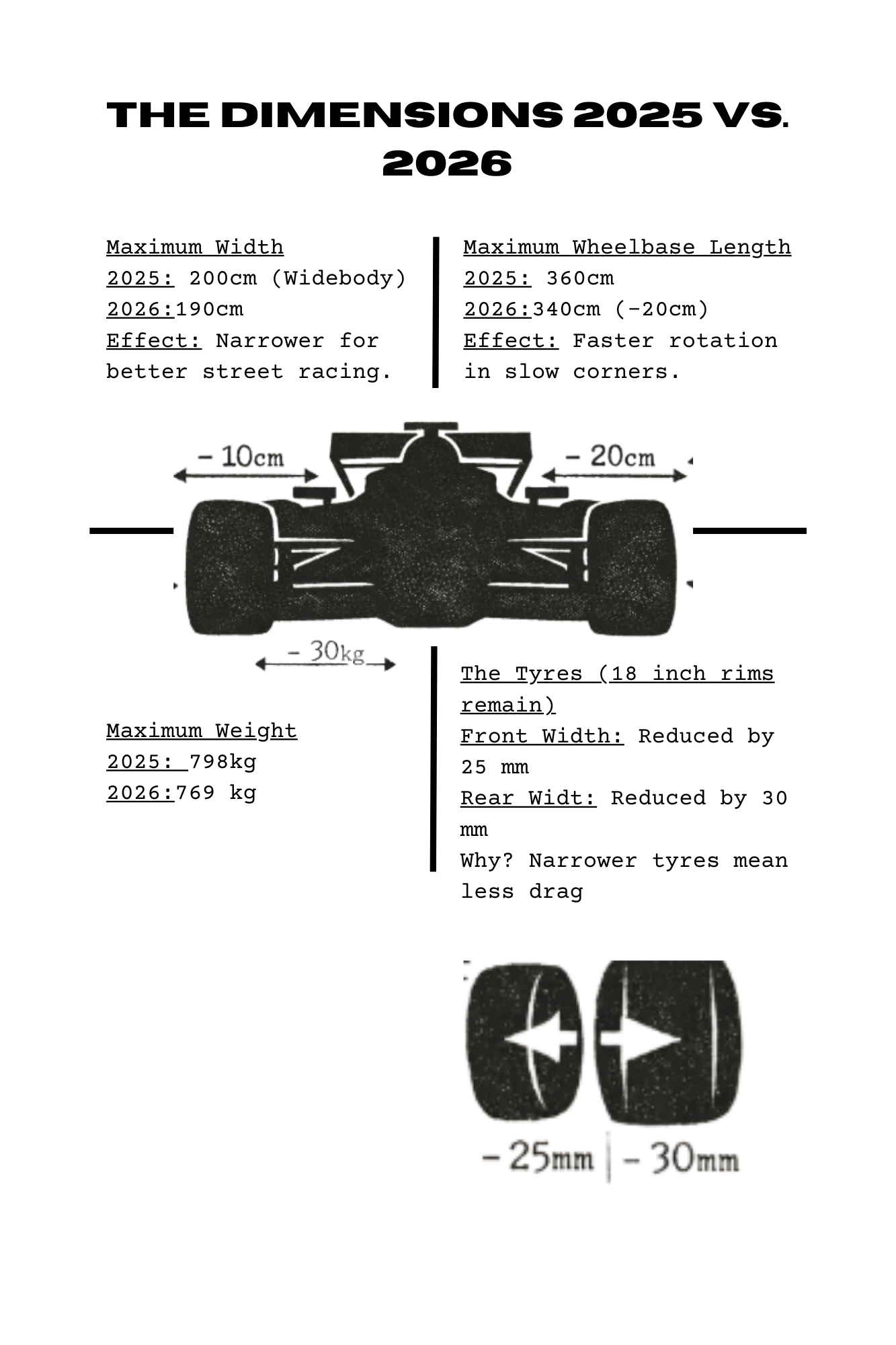
The 2026 regulations enforce a "Nimble Car" concept designed to reverse two decades of automotive obesity. Minimum weight drops by 30 kilograms to 768kg.
The cars shrink by 10 centimeters in width to 1900mm and lose 20 centimeters in wheelbase length to 3400mm.
This is not cosmetic. A narrower car creates more effective track width. A lighter car brakes later. A shorter wheelbase rotates faster through tight corners. The goal is simple. Make these machines raceable again on circuits like Monaco and Baku where the current generation struggles to pass.
But the real revolution is not visible from the grandstands.
It is hidden under the engine cover.
The 50/50 Power Split
The 2026 power unit represents a radical rebalancing of combustion and electricity. While the 1.6 litre V6 turbo engine remains, its role has been deliberately diminished.
Internal combustion power drops from approximately 550 kilowatts to 400 kilowatts. In exchange, the electric motor triples its output to 350 kilowatts, roughly 470 horsepower of raw electrical torque.
This creates a near-perfect 50/50 split between fuel and battery.
The car is no longer a combustion vehicle with electrical assistance. It is a hybrid that relies equally on both.
The MGU-H has been removed entirely to reduce development costs and attract new manufacturers.
Audi, Ford, and General Motors have all committed to the sport because of this simplification.
But simplification comes with consequences.
Energy Management Becomes the New Battlefield
Without the MGU-H, drivers can only recharge the battery through braking energy. This turns every lap into a tactical survival exercise.
Lift off the throttle too late and you fail to harvest enough energy. Brake too conservatively and the battery depletes.
Run out of battery mid-straight and the car loses half its total power instantly.
This phenomenon is called "clipping." When it happens, the driver becomes a sitting duck. Top speed collapses. Competitors with energy reserves sail past effortlessly. The race is effectively over.
This transforms what it means to be fast in Formula 1. Pure speed is no longer enough. The champions of 2026 will be the drivers who can process active aerodynamic modes, battery state, regeneration targets, and race strategy simultaneously while wrestling a low-downforce machine at 340 kilometers per hour.
Active Aerodynamics Replace DRS
The Drag Reduction System is dead.
In its place is a mandatory Active Aerodynamic System that fundamentally changes how the car moves through air.
Z-Mode is the default setting. Front and rear wing flaps sit steeply to generate maximum downforce for cornering and braking. X-Mode is the straight-line configuration. Both wings flatten to slice through the air for top speed and efficiency. Unlike DRS, X-Mode is available to every driver on every lap regardless of gap to the car ahead.
This creates a visual spectacle. The cars will physically shapeshift on every lap, transforming from high-downforce cornering beasts into low-drag missiles on the straights.
Manual Override: The New Way to Overtake
With DRS gone, overtaking is now powered purely by electricity. The new Manual Override system creates a power trap at high speeds.
The lead car's electrical deployment begins to fade at 290 kilometers per hour, hitting a soft ceiling of acceleration.
If the chasing car is within one second, they can activate Manual Override. This allows them to deploy full 350 kilowatt electrical power all the way up to 337 kilometers per hour.
The result is a massive speed differential created entirely by energy deployment rather than aerodynamics.
Overtaking becomes a chess match.
Attack now and risk running out of battery for the next lap. Save energy and risk losing track position.
Get it wrong and suffer clipping. Get it right and execute the perfect strike.
This is a brain-teaser in the making.
What This Means for Fans
The 2026 season will not reward the fastest car. It will reward the smartest strategy.
Races will be won and lost on split-second decisions about when to deploy energy, when to harvest, and when to gamble everything on a single overtake.
Expect chaos in the opening races.
The 2014 hybrid debut was plagued by reliability failures as teams struggled with the new technology.
History suggests 2026 will follow the same pattern. Cars will break. Batteries will drain. Drivers will misjudge energy deployment and hit the performance cliff mid-race.
But if the regulations work as intended, this era could produce the most unpredictable and tactically complex racing Formula 1 has ever seen.
Welcome to Year Zero.
He is Austrian, 6'5", speaks five languages, commands a $6 billion empire, and was once photographed at the No Time to Die premiere. The analysis has been done. The verdict is in.