
The Education of Little Tree
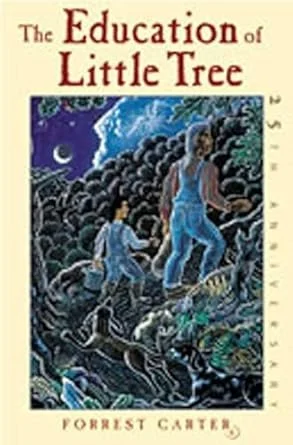
I did not find this book in a bookstore or on a syllabus. It was handed to me after school, after a conversation with a counselor that I barely remember. I know I was sad. I know I was angry. I know I had been expressing that anger in class in ways that worried adults. At the end of the talk, she gave me a paperback and told me to read it.
That book was The Education of Little Tree.
At the time, I did not know anything about its publication history or the debates surrounding its author. I only knew the story I stepped into. And stories, especially when you are young and raw, do not arrive as arguments. They arrive as companionship.
The novel follows Little Tree, a young boy orphaned early in life, who is taken in by his grandparents in the Appalachian Mountains. His grandfather, Granpa, and his grandmother, Granma, raise him according to a worldview built on patience, observation, and respect for nature. They do not shield him from hardship. They teach him how to endure it.
That was what resonated first.
I was very close to my own grandfather. He was not a sentimental man, but they were steady. Granpa’s lessons felt familiar. Not because they were exotic or romantic, but because they trusted the child to grow into understanding rather than forcing it.
One of the book's recurring ideas is "The Way." Granpa explains that there is a way to walk through the world without bending your back to cruelty or greed. This way does not make you powerful, but it makes you whole. When Little Tree makes mistakes, he is corrected quietly. Shame is not the tool. Consequence is.
There is a scene early in the book where Little Tree is taught how to trap animals for food. Granpa insists on Little Tree his respect for the animal.
Nothing is taken without purpose. Nothing is wasted. When Little Tree feels pride at outsmarting a fox, he is reminded that cleverness without humility turns into arrogance. It is a harsh lesson, but it is not punitive.
It Helped
Reading this as a child who felt misunderstood, I recognized the difference between discipline and domination.
The adults in my life were worried about my anger. Granpa never tells Little Tree not to feel anger. He teaches him what to do with it.
Loss runs through the book like a quiet current. Little Tree's parents are gone before the story begins. Their absence is not dramatized, but it shapes everything. Later, loss arrives again in different forms. The loss of safety. The loss of autonomy. The loss of a way of life.
One of the most painful sections occurs when Little Tree is taken away to a government boarding school. There, the values he learned with his grandparents are treated as backward or wrong. His name is changed. His language is mocked. His connection to the land is severed.
This section is often cited because it reflects real historical practices in the United States, where Indigenous children were removed from their families and placed in boarding schools designed to enforce assimilation. The book presents a fictionalized account, but the policy itself is well documented. Children were discouraged or punished for speaking their languages or practicing their cultures. The aim was not education but erasure.
The section is devastating. Little Tree survives not by rebellion, but by remembering who he is. He internalizes his grandparents' teachings so deeply that they become portable. Even in confinement, he walks "The Way" internally.
That idea stayed with me.
The book does not pretend that survival is painless. When Little Tree eventually returns to the mountains, he is changed. His grandparents are older. The world has narrowed. And eventually, inevitably, he must face their deaths.
The way the novel handles this is restrained. There is no dramatic farewell. No speeches. Loss is absorbed the way it often is in real life. Quietly. With dignity. With the understanding that grief is not something to be solved, but something to be carried.
As a reader, you walk alongside him through these moments. You feel the weight without being instructed how to feel. And then, at the end, you leave him.
The final departure mattered to me. Little Tree does not remain frozen in childhood for the comfort of the reader. He is prepared to enter the world on his own terms. The relationship ends not because it fails, but because it succeeds.
Years later, learning more about the book complicated my relationship with it.
The author, Forrest Carter, was later revealed to be Asa Earl Carter, a man who had publicly supported segregation and white supremacist ideology earlier in his life. This revelation led to significant controversy around the book, especially after it gained popularity in the 1990s and was marketed as autobiographical, which it is not.
These facts matter. They should not be ignored.
The book presents itself as drawing from Cherokee traditions, but Carter himself was not Cherokee, and many of the cultural representations are simplified or romanticized. Scholars and Indigenous writers have criticized the novel for blending truth, fiction, and appropriation in ways that can mislead readers. Holding that knowledge now does not erase my earlier experience of the book, but it reframes it.
What I connected to was not authenticity in an anthropological sense. It was emotional truth. The relationship between child and elders. The teaching through patience. The acknowledgment that loss is formative, not exceptional.
This does not excuse the book's problems. It contextualizes my response to it.
As an adult, rereading The Education of Little Tree requires discernment. It means recognizing both what the book gave me and what it obscures. It means understanding that stories can carry genuine comfort even when their origins are compromised.
The book helped me at a time when I needed to learn how to hold myself together without hardening. It offered a model of strength that did not rely on dominance.
I would not recommend the book without conversation now. But I would not deny its impact either.
Some books arrive when you are not looking for literature. They arrive when you are looking for a way to stand upright again. This was one of those books for me.
And that, complicated as it is, remains true.