
From Chaturanga to Upward Dog Without Collapsing
For my entire first year of vinyasa practice, I had no idea how to do the small dive motion in the chaturanga flow from up dog to downward facing dog. "Chaturanga to Upward Dog."
I lowered my knees mid-transition. Just enough to give myself leverage for the backbend.
Now I'd be the first to say that modifications are key to the practice, but for me personally, I wanted to figure out this move without the modification and wanted to figure out which muscle groups needed some extra strength to manage it.
My shoulders would drop below my elbows, my chest would cave, and then, trying to salvage Upward Dog, I'd either face-plant or rely on my knee save.
Watching advanced students glide seamlessly from low push-up to graceful backbend felt like magic.
Their bodies moved as one integrated unit. Mine felt like it was fighting itself. Which is not very yoga, I believe.
The breakthrough didn't come from forcing more reps. It came from finally understanding what was supposed to happen.
This transition isn't about pushing harder. It's about recruiting the right muscles in the right sequence while protecting alignment.
Once I learned which muscle groups needed to fire, and in what order, the movement stopped being an exhausting battle and became fluid.
Why This Transition Defeats Most People
Chaturanga to Upward Dog demands precise timing and coordination across five major muscle groups.
And in daily motion we don't always use these muscle groups, so therefore the strength needed makes this position a considerable challenge the first time you encounter it.
Most practitioners struggle for three main reasons.
First, their Chaturanga is already collapsing. Shoulders dipping, elbows flaring, hips sagging. You can't transition forward from a broken starting position.
Second, they rely almost entirely on upper-body pressing power and ignore core engagement, which is what actually drives the movement.
Third, they lack the specific strength patterns this transition requires (different from a standard plank or push-up).
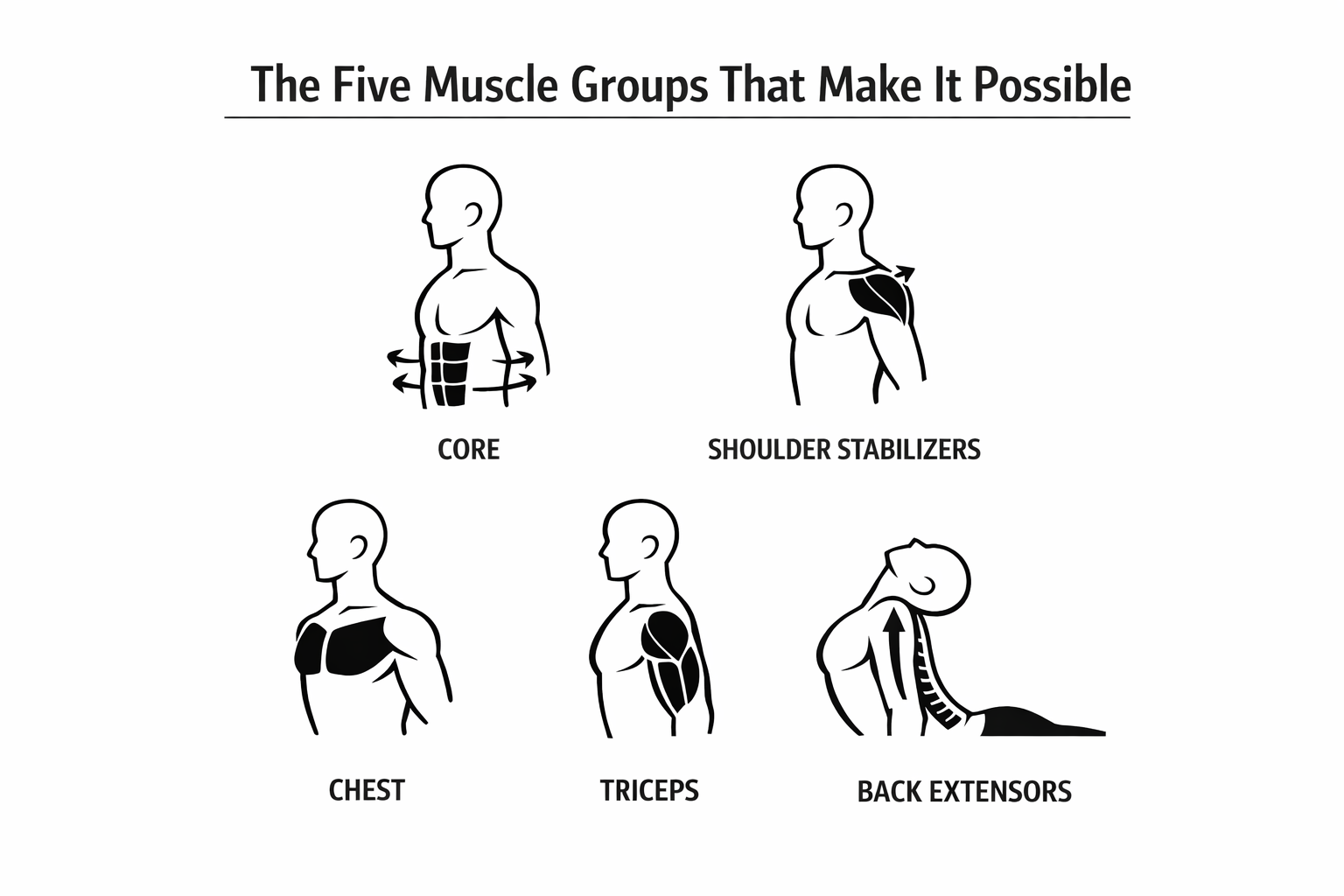
The Five Muscle Groups That Make It Possible
When I finally looked at the anatomy, it all made sense. My body wasn't "weak." It just hadn't yet built the right coordination.
Core creates internal stability, prevents pelvic tilt in Chaturanga, keeps the body rigid during the shift, and protects the lower back in Upward Dog.
Shoulder stabilizers keep the joint solid during the complex angle changes. Weak stabilizers let the shoulders dive below the elbows.
Chest (pectorals) delivers the horizontal pressing force that propels you forward (this is different from vertical push-up power).
Triceps extend the elbows from bent (Chaturanga) to straight (Upward Dog). Weak triceps equals mid-transition collapse.
Back extensors actively lift and lengthen the spine into the backbend. The arch should come from strong back engagement, not from crunching the lower spine.
The Forward Shift
Here's the key insight I missed for months. This transition is not primarily an upward push. It's a forward shift first. Your shoulders need to travel several inches past your wrists before you press up into the backbend.
The chest moves forward, then you lift. Most people try to press straight up from Chaturanga without shifting forward. That demands far more raw strength and usually ends in collapse.
The forward shift does two crucial things. It repositions your center of gravity so the lift requires less force. It aligns your shoulders slightly ahead of the wrists in Upward Dog (the anatomically correct position).
At first, shifting forward felt impossible. I could barely hold Chaturanga. But learning that forward glide was what finally made the whole movement possible.
Patience Over Force
Forcing fifty sloppy transitions per class only reinforces bad patterns.
Patient, progressive building creates real strength. Instead of crashing repeatedly, I broke the transition into stages and trained systematically.
A Six-Week Plan
Weeks 1 to 2
The goal is to create full body tension and joint stability before adding movement.
High Plank holds. Straight arms. Shoulders stacked directly over wrists.
Press the floor away so the upper back stays active.
Brace the core and lightly tuck the pelvis to avoid sagging or piking. Start with 30 seconds and build to 60 seconds with clean form.
Chaturanga holds. Lower to Chaturanga and hold for 20 seconds. Elbows at roughly 90 degrees, hugging in toward the ribs. Use blocks under the hands if you cannot maintain shoulder height above elbow height. Keep the body in one straight line.
Negative Chaturangas. From High Plank, lower slowly into Chaturanga over 5 to 10 seconds. Control the entire descent. Stop if you lose shoulder position or collapse through the chest.
Cobra holds. From prone, lift into Cobra using back strength, not arm push. Keep the pelvis grounded. Hold for 20 to 30 seconds to build active back extension.
Weeks 3 to 4
The goal is to connect strength to the actual transition mechanics.
Forward shift practice. From Chaturanga, shift the chest forward and slightly up without lifting or straightening the arms. Feel how the shoulders move past the wrists. Keep elbows bent and ribs controlled.
Knees down transitions. Practice full Chaturanga to Upward Dog transitions with knees on the floor to reduce load while keeping correct mechanics.
Upward Dog holds. Build to 20 to 30 second holds with active legs, lifted thighs, and strong back engagement. Do not dump into the lower back.
Weeks 5 to 6
The goal is clean, controlled full transitions under fresh conditions.
Full transitions. Attempt 2 to 3 clean Chaturanga to Upward Dog transitions per practice, only when fresh. Stop before form degrades.
Blocks for support. Use blocks under hands if shoulder depth or strength is limiting clean mechanics.
Film for alignment. Check elbow angle, shoulder depth, and spinal line. Look for collapse or excessive lower back compression.
Quality first. Fewer clean reps beat many sloppy ones.
Targeted strengtheners (20 minutes, 3 times per week).
Boat Pose and hollow body holds to build deep core bracing.
Resistance band shoulder external rotations to strengthen stabilizers.
Push ups and tricep dips to build horizontal pressing strength.
Superman holds and Cobra variations to strengthen back extensors.
Twenty focused minutes three times a week beats hours of struggling through bad transitions.
A Breath Pattern That Helps
Exhale lowering into Chaturanga. This naturally engages core and stabilizes spine.
Hold your breath briefly at the bottom. Inhale as you shift forward and press into Upward Dog.
The inhalation lifts the chest and supports the backbend. Good breathing coordinates the muscle firing sequence and makes the whole thing feel more manageable.
Chaturanga to Upward Dog is just one transition.
Mastering it means developing core stability, shoulder integrity, coordinated strength, and respect for where your body is today.
Six weeks of focused work can transform the transition.
But the real gift is how you learn to meet every challenge on the mat, with curiosity, patience, and respect for the process.
If you're struggling with this (or any other) transition, try the six-week plan.
Start small, be consistent, and the body will meet you halfway.
Namaste, Se